
Services
We take a legacy system from understood to replaced: its rules extracted, a modern application built to do the same job, its data migrated, and the result proven against the original. Every engagement has a defined scope, named deliverables and agreed acceptance criteria.
Application rewrite to a modern equivalent
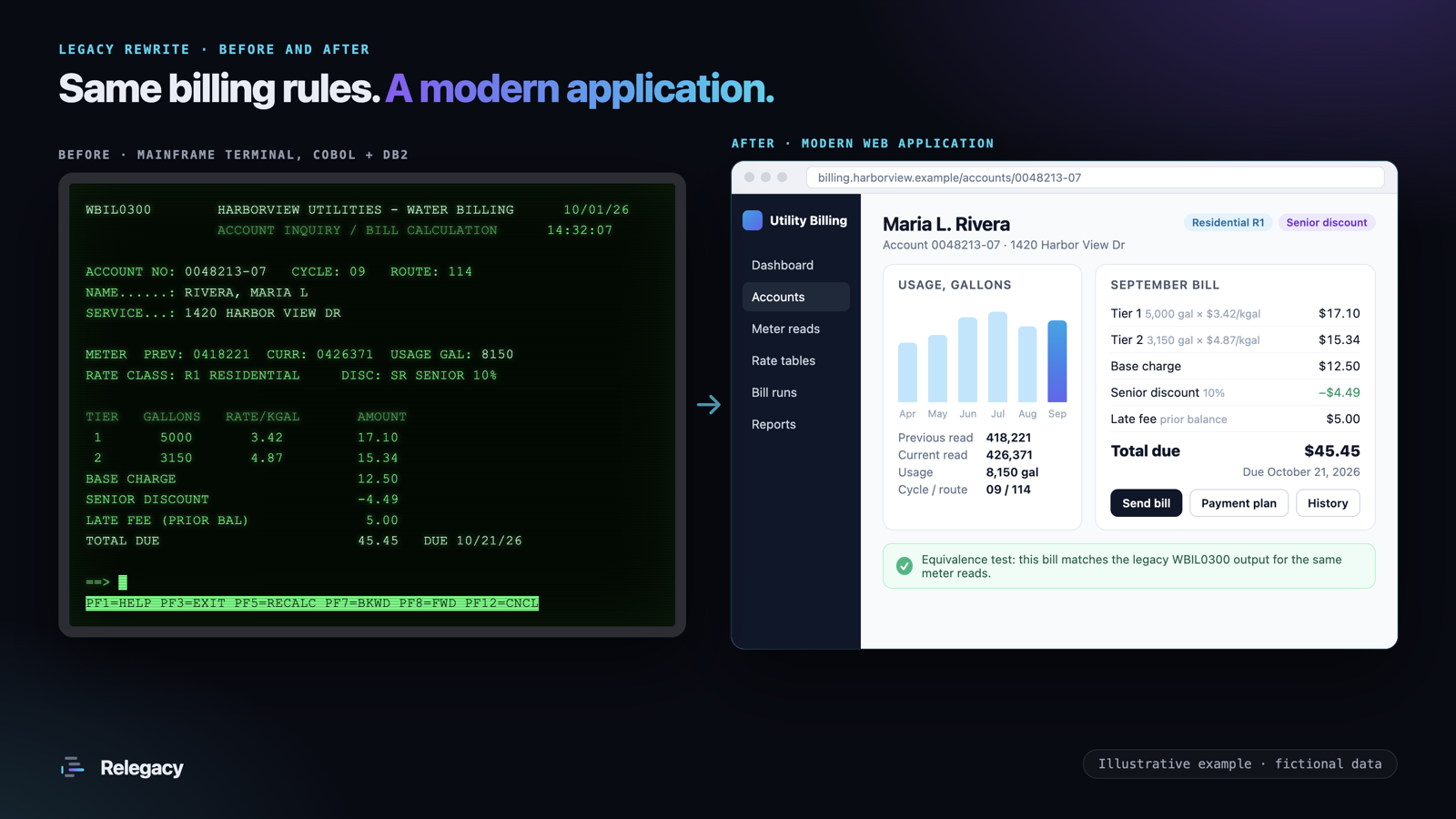
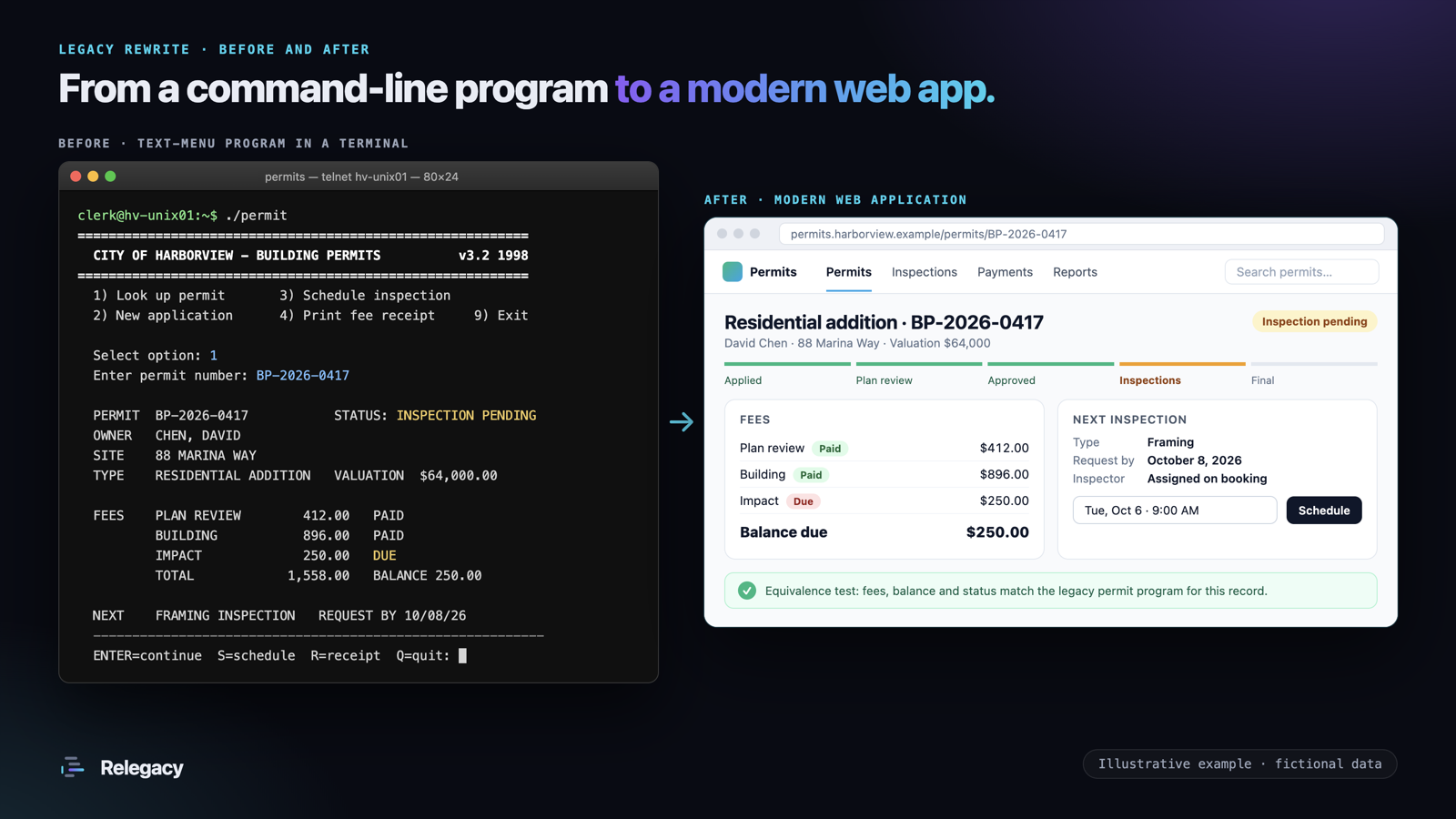
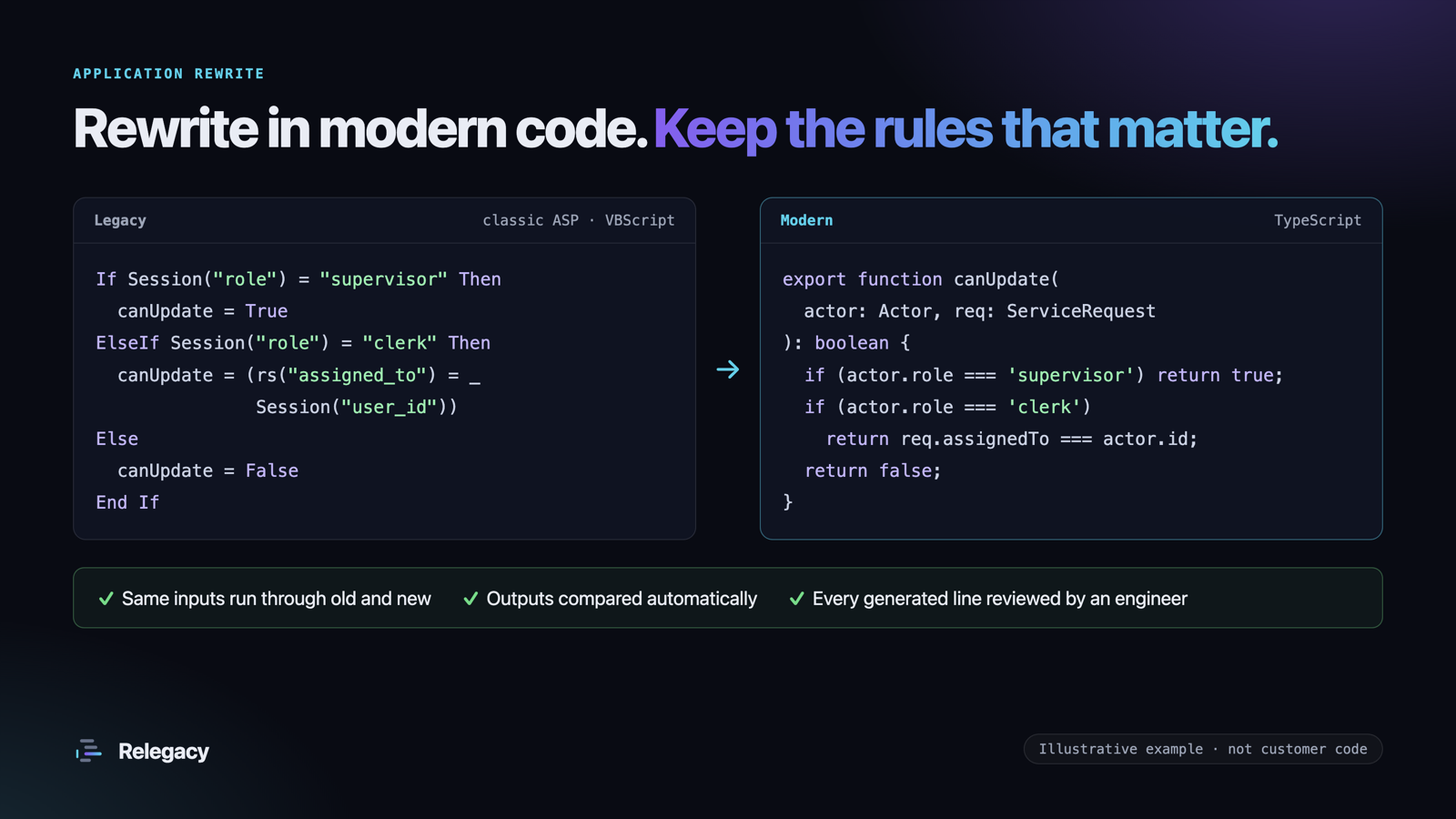
A COBOL program, a classic ASP or Visual Basic application, an Access database or an aging .NET system becomes a modern application that does the same thing: the same calculations, rules, permissions and reports, on a current framework your team can support. This is not a line-by-line translation that keeps old problems in new syntax. We rebuild the functionality with modern structure, and we rewrite in stages, one module or workflow at a time, so the old system keeps running until each new piece has been proven against it.
- What you receive: a working application with a web interface for staff, APIs for other systems, scheduled jobs in place of batch runs, and a modern database
- Modern frameworks: for example React or Next.js front ends, TypeScript and Node.js services, or .NET or Java where that fits your team, on PostgreSQL, SQL Server or a cloud-managed database, chosen with you for hosting, security and support needs
- Business rules extracted from the old code first, so the new application reproduces what the system actually does, not what old documents say it does
- AI-assisted development, with every change reviewed by an engineer before it is accepted
- Equivalence tests that run the same inputs through the old and new systems and compare the outputs, such as bills, eligibility decisions and reports
- Readable, documented code and deployment instructions your team or another vendor can maintain, with no lock-in to our tools
Legacy data migration
Extract, clean and transform data from legacy databases and file formats into a modern database, and prove that nothing was lost or changed along the way.
- Typical sources: IBM DB2, Oracle, older SQL Server, Informix, Sybase, Microsoft Access, FoxPro and dBase, plus flat files, fixed-width exports and COBOL record layouts, each confirmed during the assessment
- Targets: PostgreSQL, current SQL Server or a cloud-managed database of your choice
- Data profiling that finds duplicates, missing values, invalid codes and encoding problems before migration
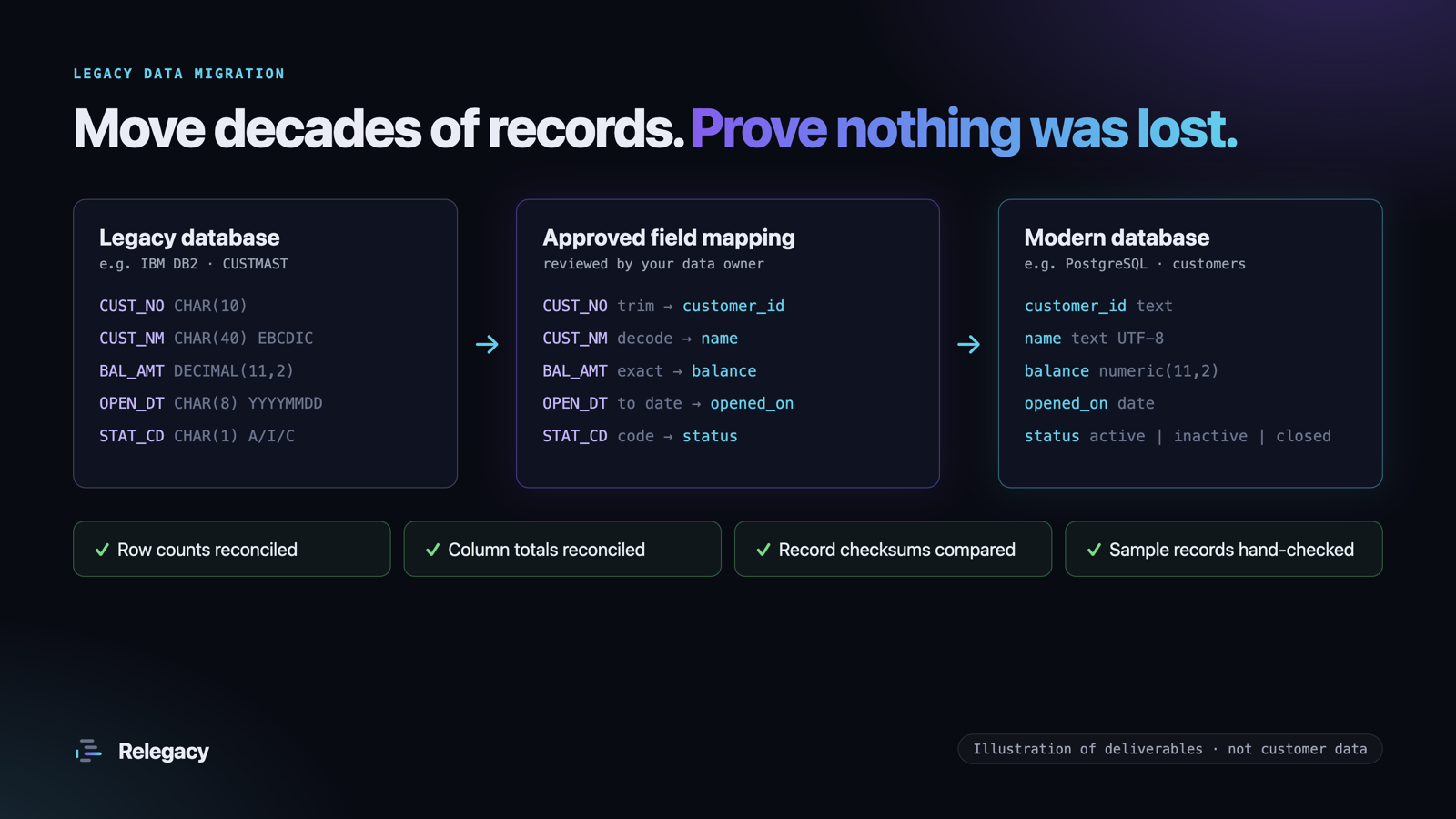
- A field-by-field mapping document, approved by your staff, showing where every column goes and how it changes
- Repeatable extract-and-load scripts that can be rehearsed as many times as needed before cutover
- A reconciliation report comparing row counts, totals and checksums between old and new, with sample records checked by hand
- Cutover and rollback plan, with an optional period of running both systems side by side
Your data stays in your environment. Migration scripts run on systems you control, under your access rules. We do not copy production records to our own machines unless an agreement allows it.
Modernization assessment
The usual first step: for one application and an agreed set of artifacts. It tells you what the system really does and what it will take to replace it. Also useful before an upgrade, a procurement decision, or when the people who knew the system have left.
- Inventory of programs, languages, databases, files and integrations
- Documented business rules, each linked to the source it comes from
- Risks, outdated components and open questions the source cannot answer
- Recommended target stack, a staged rewrite and migration plan, and a scoped, fixed-price next step
Modernization pilot
A small, fixed-price first step that proves the approach before a larger commitment. Examples: rewriting one module, migrating one database table group, adding a new interface to an old workflow, or updating an outdated runtime.
- Approved change plan
- Reviewable code changes or migration scripts
- Before-and-after tests for the behavior and data you care about
- Validation report, known issues and rollback notes
Production deployment stays under your team's control and change process.
Subcontract support
For prime contractors delivering modernization programs: application documentation, dependency analysis, code conversion, data migration and regression validation for defined task areas.
Technologies
New applications are built on modern web, mobile and API stacks, such as TypeScript and Node.js, React, and current SQL databases. Our analysis software is strongest today on JavaScript and SQL, and support for other languages is being added step by step.
Legacy platforms such as DB2, Oracle, COBOL, older .NET and Visual Basic, classic ASP and Access are assessed project by project. Where a project needs deep platform experience we do not have in-house, we bring in a qualified specialist partner and tell you so in the proposal. Every project starts with an assessment of your specific stack, and we tell you plainly what we can and cannot deliver before you commit.